
Pre-seed · in development

Bringing compute to power.

ArcLoom finds small pockets of power already on the grid and pools them into rack-ready capacity for AI operators. You bring the hardware.

Illustration: ten small sites across a dark plain at night, pooled into one block A wide plain at night, seen from above. Ten small sites lie spread across it, each a pocket of gold light: substations, small plants, generators, solar with storage and utility yards, each with a Databox set beside it. A thin violet line rises from every site to its own tile in one block that hovers over the land. Ten tiles of 2 MW make the proposed 20 MW pilot.
Pool

Ten small sites each add 2 MW, pooled into one block: the proposed 20 MW pilot.

Today: new grid connection, primary markets
4+yrs
ArcLoom target, order to customer-ready
3–6mo
What each site adds to the pool: one Databox
2MW
Proposed pilot: the first 20 MW pool
20MW

4+ years: ArcLoom, Time to Power white paper v1.7. ArcLoom figures are targets and plans, not delivery records.

The demand is here.
The power isn't.

The biggest buyers of AI capacity say they can't get enough of it. New power can't be connected on their timeline.

“There's just nowhere near enough compute for all the demand.”

Mark Zuckerberg, CEO, Meta Q2 2026 earnings call, July 29

“We will still not have enough capacity to meet all the demand we have in 2026.”

Andy Jassy, CEO, Amazon Q2 2026 earnings call, July 30

“We continue to be supply constrained.”

Sundar Pichai, CEO, Alphabet Q2 2026 earnings call, July 22

Months until capacity can be used

8–12 weeks

AI chips Typical lead time, 2024

4+ years

New grid connection Primary data-center markets

3–6 months

ArcLoom target Databox order to customer-ready

1.4%

North American data-center vacancy in the first half of 2026, a record low.

CBRE · H1 2026

63 GW

Projected US gap by 2033 between the data centers AI chips call for and what power allows.

BloombergNEF · Jul 2026

Built to skip the wait.

Three choices that cut the wait.

  • Many small sites, one power pool

    Pockets of power too small for conventional developers, qualified one by one. Each site stays where it is; together they are sold as one pool of capacity.

  • Power that is already on

    Every site we qualify already has its grid connection. No new large-load connection to wait for, and no new power plant to build.

  • Space, not compute

    Your racks, your servers, your customers. ArcLoom sells powered space and never competes with the operators it serves.

A map of the United States with the eight Mountain West states raised and outlined in gold: Arizona, Colorado, Idaho, Montana, Nevada, New Mexico, Utah and Wyoming.
  • Utah: best estimate 315 MW, range 105 to 661 MW
  • Colorado: best estimate 225 MW, range 59 to 447 MW
  • Wyoming: best estimate 165 MW, range 40 to 320 MW
  • New Mexico: best estimate 157 MW, range 68 to 273 MW
  • Montana: best estimate 115 MW, range 28 to 183 MW
  • Idaho: best estimate 92 MW, range 2 to 260 MW
  • Arizona: best estimate 90 MW, range 13 to 153 MW
  • Nevada: best estimate 11 MW, range 5 to 86 MW

1,170 MW

Spare power in the eight Mountain West states, available now or within three years: our study's best estimate.

Range: about 320 to 2,400 MW.

ArcLoom Mountain West study · Oct 2026

Sources: Meta, Amazon and Alphabet Q2 2026 earnings calls; CBRE, North American Data Center Trends, H1 2026 (via CIO Dive, Sep 3, 2026); BloombergNEF, US data center outlook, Jul 2026; ArcLoom, Time to Power white paper v1.7 (grid connections, chip lead times); ArcLoom, Mountain West spare-capacity study, Oct 2026. ArcLoom figures are targets and models, not delivery records.

Find the power first.
Then add it to the pool.

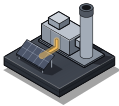
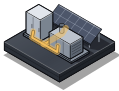
A landscape tile with three small host sites: a generator, an industrial site and a substation. Spare power is found at the substation, a pad is laid beside its existing service, the customer’s racks are matched to it, a Databox is set down, and the site is tied into the pool with the others.

Every site must pass the same checks

  • Land
  • Power
  • Permits
  • Fiber
  • Cost

Factory-built. 2 MW.
What's inside.

Target: 3–6 months from order to customer-ready

One module, two rooms.

A factory-built module with a compute room and a plant room, split by a sealed wall. Power and heat-rejection equipment sit beside it in the yard.

The customer brings

Your racks. Your software. Your workload.

Customer racks line one wall of the compute room, fed by overhead power and liquid cooling at the rack.

2 MW total facility load · Modeled critical IT capacity: 1.45 MW

ArcLoom supplies

Plugs into existing power and fiber.

Host power steps down in an electrical skid beside the box, enters through a meter and service disconnect on the outside wall, and runs to an overhead busway that feeds every rack. Fiber enters a meet-me room in the plant, where the customer’s connectivity takes over.

ArcLoom supplies

Liquid cooling, clean air.

Coolant distribution units in the plant room carry heat from the racks to dry coolers in the yard. Filtered air comes in through side-wall louvers, and exhaust leaves through vents on the roof.

ArcLoom supplies

Protected and controlled.

Detection and clean-agent suppression cover both rooms, with a sealed wall between compute and plant. An equipment door serves the compute room and a personnel door the plant room, with controlled entry built into the design.

  1. Compute room
  2. Plant room
  3. Yard · power + cooling
  1. Customer racks
  2. Overhead power
  3. Liquid cooling at the rack
  1. Electrical skid
  2. Meter + service disconnect
  3. Meet-me room · fiber
  1. Coolant distribution units
  2. Dry coolers
  3. Side-wall louvers
  1. Sealed wall
  2. Detection + suppression
  3. Controlled entry
One Databox · 2 MW of the proposed 20 MW pool

Relocatable by design

If a host needs its power back, the Databox is designed to move. To be proven in operation.

The hard part is power. This team has built, permitted and run it.

Devin Pehrson

Devin Pehrson

FounderPresident and Manager

Former energy-company CEO and senior finance executive with full CFO responsibilities

  • Diverse energy background spanning oil and gas, power generation, solar and battery storage
  • Structured acquisitions, joint ventures, offtake and power purchase agreements
  • Grew a one-person operation into a diversified organization with 300+ team members
  • Navigated energy development across federal, state, county and tribal jurisdictions

Dusty Monks

Dusty Monks

Co-founderChief Commercial Officer

Former Deputy Director and Interim Director, Utah Office of Energy Development

  • Led development of Utah's Strategic Energy Policy
  • Central role in launching Operation Gigawatt, Utah's plan to double power production
  • Developed and implemented the Utah Strategic Nuclear Pathway project
  • Built and sold two businesses; led operations at GE Oil & Gas and Baker Hughes

Advisors

Dan Phillips

Power development

Former VP Development, NRG Energy. Developed the 360 MW Texas City peaker and 150 MW Buckthorn solar.

Travis Lindsey

Counsel

Principal, TRL Energy. More than 20 years in energy, tribal and federal agreements.

Blake Buxbaum

Implementation

Built the Willow Creek Microgrid: 2 MW solar, 3 MWh battery, 700 kW gas.

Operators need power. Hosts have it.

For compute operators

We sell the date your power is on.

Skip the grid queue. Bring your own racks, servers and software. ArcLoom provides the facility, power, cooling and fiber, by the kilowatt. Suited to inference and other workloads that can flex on a planned schedule.

Target: customer-ready 3–6 months from Databox order.

AI inference · hosting platforms · chip makers · model makers

Discuss capacity

For site hosts

Put spare power to work.

Have spare power at a substation, a plant or an industrial site? ArcLoom sets a Databox on your existing service, adds your site to the pool and operates it. Power you already have becomes a new source of revenue.

Co-op and municipal utilities · industrial sites · generators

I have spare power

Time to Power: the case for distributed capacity.

Why time to energized space matters, what the grid queue costs AI capacity, and how many small sites of existing power could serve flexible compute.

Read the white paper
  1. Now Identifying candidate sites and developing the Databox design.
  2. Next The proposed 20 MW pilot.

Discuss a role in our first deployment.

The proposed pilot is the first 20 MW pool. Operators and hosts who talk with us now help shape where it goes.

Operators: tell us your megawatts, location and timing.

Hosts: tell us where your spare power sits.

Or email devin@arcloominfra.com

Pool 20 MW. Ten small host sites, each with a Databox set on the host’s existing power, joined by one line into the proposed 20 MW pool.

Questions about ArcLoom.

What does ArcLoom provide?

ArcLoom is developing rack-ready AI capacity by pooling small sites with existing power. We provide facilities, power, cooling and connectivity; customers own the racks, servers and software.

What is a Databox?

A relocatable facility designed for a target total load of 2 MW, housing customer compute, cooling, fire suppression and network equipment.

What is a capacity pool?

Multiple sites offered as one commercial capacity pool. Each stays at its own location, not one physical campus or tightly connected compute cluster.

Which workloads fit?

Latency-tolerant inference: batch processing, asynchronous generation and evaluation. Workloads must suit each site's location, connectivity and agreed operating flexibility.

Is the power redundant or uninterrupted?

No. The initial service is utility-grade, without a redundant feed or backup plant. Workloads must tolerate interruptions and agreed load reductions, with terms assessed site by site.

What stage is ArcLoom at?

ArcLoom is in pre-seed development and validation; the pilot is proposed. The customer-ready target is 3 to 6 months from Databox order, subject to site verification and agreed terms.

Read the research